The Skills That Quietly Went Extinct — and What We Got in Exchange
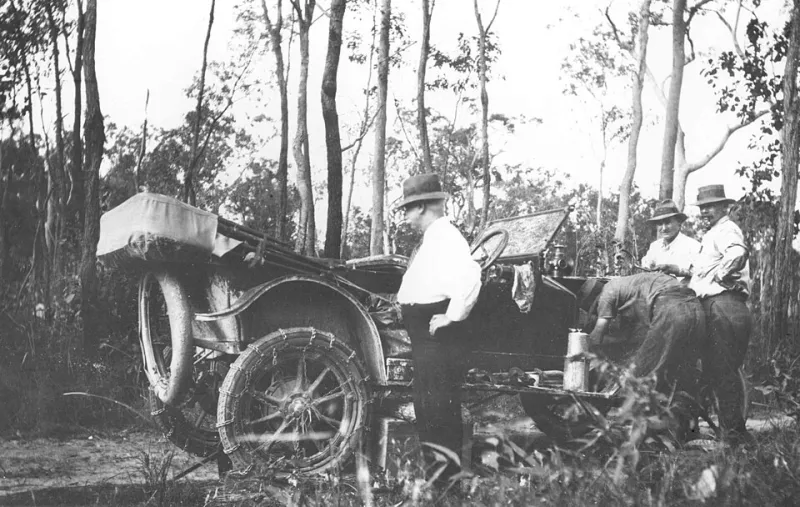
Photo: Queensland State Archives, PDM-owner, via Wikimedia Commons
Capability on Layaway
Every generation hands the next a strange inheritance: a list of skills that no longer matter. Your great-grandparents would be helpless in a modern airport, but drop most of us into their 1925 world and we'd struggle to buy bread, board a train, or keep food from spoiling. Here are five everyday competencies that quietly went extinct — and the fair question of what, exactly, we traded for them.
1. Reading a Train Timetable
Once upon a time, navigating America meant decoding a dense grid of arrivals, departures, and connecting lines. Knowing that the 4:15 out of Harrisburg met the 7:40 local in Pittsburgh was a genuine literacy — one wrong assumption and you were stranded in a strange town overnight.
The replacement: an app that plans the entire route, down to the platform. We gained certainty and lost the satisfying mental gymnastics of threading a journey together ourselves. The old skill was really about spatial reasoning and planning under uncertainty — things no app teaches anymore.
2. Driving a Stick Shift
In 1980, most cars sold in America had three pedals. Today it's a few percent, and rental counters report that many drivers under 30 can't operate a manual at all. Knowing how to work a clutch once meant you could drive anything — a borrowed pickup, a vintage car, a getaway vehicle in a movie.
The replacement: automatics and, soon, no pedals at all. This one's hard to mourn. The manual transmission existed to compensate for engine limitations, not to build character. But there's a kernel of loss: a machine you had to listen to, feel, and coordinate with, versus one that simply obeys.
3. Preserving Food Without Refrigeration
Canning, salting, smoking, root cellars — for most of American history, keeping food from rotting was a seasonal arms race. A good homemaker could take a July garden and make it feed a family in January. This wasn't a hobby; it was infrastructure.
The replacement: the refrigerator and the global supply chain, which made every food available every day. The trade was almost entirely worth it — but the result is a population with almost no idea where food comes from or how fragile the system behind it is. The pandemic's empty shelves gave us a brief, unsettling glimpse of what our great-grandparents always knew: abundance is a machine, and machines break.
4. The Card Catalog and the Dewey Decimal Dance
Finding a book once required understanding a system: subject headings, card drawers, decimal numbers that mapped knowledge itself. It took effort, and the effort taught you how information was organized — that ideas had neighborhoods and neighbors.
The replacement: the search bar, which returns everything instantly and teaches you nothing about structure. We traded a map of knowledge for a magic lamp. The rub: a search engine only shows you what you already knew to ask for. The card catalog, browsed at random, regularly handed people ideas they weren't looking for.
5. Mental Math at the Counter
Before registers that announce your total, shoppers tracked prices, estimated tax, and counted change in their heads — because the clerk might get it wrong, and because there was no other option. A grocer could total a basket of fifteen items before the customer reached the door.
The replacement: the machine that does it, plus the phone in your pocket that does everything else. Nobody seriously wants to return to hand-computed change. But researchers who study 'cognitive offloading' have a nagging finding: capabilities you never practice tend to atrophy. The skill wasn't just arithmetic — it was a habit of holding numbers, and confidence, in your head.
What We Actually Traded
Look across all five and a pattern emerges. In every case, we exchanged a capability for a convenience — and the convenience is, honestly, better for most people most of the time. That's why the skills died; nobody votes to keep doing things the hard way.
But there's a difference between outsourcing a task and forgetting that the task exists. Our great-grandparents understood the systems underneath their lives — food, travel, information, money — because they had to operate them by hand. We ride on top of systems we can't see.
Maybe the skill worth reviving isn't any one of the five. It's the habit of occasionally lifting the hood — canning a batch of tomatoes, driving a manual, doing the math in your head — just to remember how the world works when the machine isn't holding it together.