When Getting Sick Meant the Whole Family Showed Up — Before Hospitals Became Places You Enter Alone
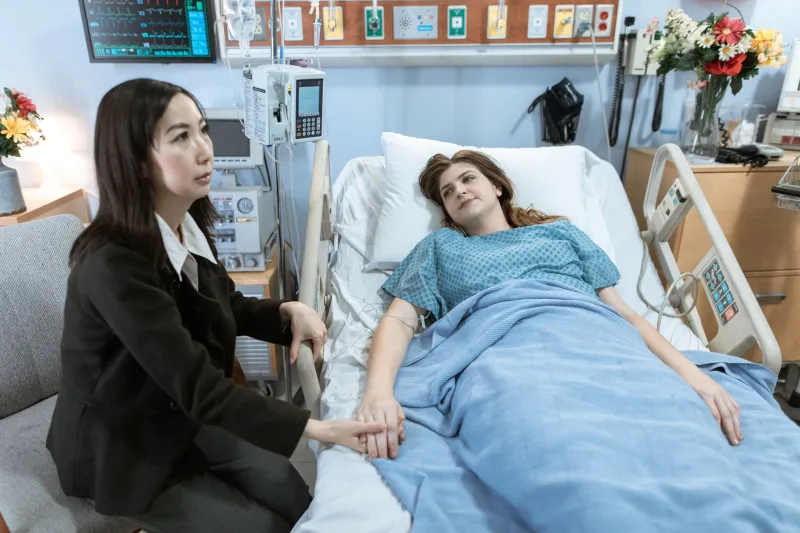
There's a photograph from 1955 that you've probably seen a version of, even if not this specific one. A hospital room with a large window letting in afternoon light. A patient in bed, propped up on pillows. And around that bed — a spouse, two adult children, maybe a grandchild perched on the edge of a chair, everyone leaning in slightly, talking. The room feels crowded. It also feels alive.
That image captures something real about how illness was once experienced in America — not as a private medical transaction, but as a communal event that the people who loved you showed up for, physically and persistently.
Something has changed since then. The medicine has improved dramatically. But the experience of being a patient has shifted in ways that don't always feel like progress.
When the Family Was Part of the Treatment
Through much of the mid-twentieth century, American hospitals operated on the assumption that family presence was a natural and beneficial part of patient care. Visiting hours were long — often running from mid-morning through early evening, with some hospitals allowing extended stays for seriously ill patients. Relatives didn't just stop by; they camped out. They brought food from home. They sat with patients through the tedious, frightening hours between doctor rounds. They asked questions of nurses and sometimes helped with basic care in ways that felt normal rather than intrusive.
This wasn't just sentiment. It reflected a genuine understanding that patients fared better when they weren't alone. Anxiety decreased. Compliance with treatment improved. Recovery times were shorter in patients with consistent family support. The hospital, for all its clinical machinery, was still understood as a place where human beings were healing — and human beings heal better in the presence of people who love them.
The relationship between the medical staff and the family was also different. Doctors spoke to relatives directly, explained conditions in plain language, and treated the family as partners in the patient's care rather than obstacles to efficient treatment. A patient's wife might know more about their medication history than any chart in the hospital, and that knowledge was valued.
Outside the hospital, illness was managed communally too. Neighbors brought casseroles. Church members organized visiting schedules. The sick person's household was absorbed, temporarily, into a wider network of practical support that just appeared without being formally arranged.
How the System Reorganized Itself
The transformation didn't happen overnight, and it wasn't driven by any single decision. It was the accumulation of changes that each made sense individually but together reshaped the entire experience.
Hospitals grew larger and more specialized through the 1970s and 80s. The logic of efficiency became dominant. Shorter stays meant lower costs. Tighter visiting policies meant fewer disruptions to clinical workflows. Infection control protocols — genuinely important, especially in ICUs and post-surgical settings — provided a medical rationale for limiting family access that was sometimes applied far more broadly than the evidence required.
Insurance structures changed the economics of care. The pressure to discharge patients quickly became intense. A hospital stay that once lasted a week for a procedure now lasts two days. There simply isn't enough time for the old model of family presence to take hold before the patient is sent home with a folder of instructions and a follow-up appointment three weeks out.
The physical design of hospitals changed too. Older hospitals often had larger, more social rooms. Newer facilities, built around efficiency and infection control, feature smaller rooms, more restricted corridors, and waiting areas deliberately positioned away from patient care areas. The architecture itself communicates that family is a visitor here, not a participant.
And then COVID-19 arrived and, for a period, removed family from the hospital picture entirely. Patients spent their final hours, or their terrifying uncertain hours, without anyone they knew beside them. It was medically defensible during the acute crisis. It was also, by almost any human measure, a catastrophe — and it revealed how much the gradual erosion of family presence had already changed the baseline before the pandemic made it absolute.
What Patients Actually Experience Now
Ask anyone who has spent significant time in a modern American hospital — as a patient or as a family member trying to be present — and the word that comes up most often is "alone."
Not necessarily because the staff is unkind. Most hospital workers are working under enormous pressure and doing their genuine best. But the system is organized around throughput, documentation, and risk management in ways that leave little structural room for the slower, messier work of human accompaniment.
Visiting hours in many facilities are still technically generous, but the reality is more complicated. ICU access is restricted. Surgical waiting rooms are physically separated from recovery areas. The patient is moved between departments — imaging, surgery, recovery, a regular room — in ways that make it difficult for family to stay oriented, let alone present. Discharge happens fast, often with little warning, and the instructions handed over assume a level of medical literacy and home support infrastructure that not every family has.
The communal support structure that once surrounded illness has also thinned considerably. Fewer people belong to religious communities that organize practical help. Neighbors are less likely to know a family well enough to show up uninvited with food. The informal networks of mutual aid that once absorbed the shock of serious illness have contracted alongside the broader decline in community life.
The Evidence Is Hard to Ignore
Research on patient outcomes consistently supports what common sense suggests: people do better when they're not alone. Studies show lower rates of delirium in elderly patients with consistent family presence. Better pain management outcomes. Higher rates of medication adherence after discharge. Faster return to baseline function.
Some hospitals have taken this seriously. The "patient-centered care" movement of the 2000s pushed for more flexible visiting policies, family participation in rounds, and care models that treat relatives as partners rather than complications. Some facilities have genuinely embraced this. Many have adopted the language without fully changing the practice.
The challenge is that family-centered care is harder to measure than throughput metrics and harder to bill for than procedures. In a system organized around what can be quantified, the things that matter most to patients — feeling known, feeling accompanied, feeling like more than a case number — tend to lose out.
The Thing That Medicine Hasn't Fixed
American medicine in 2024 is extraordinary by almost any historical measure. Conditions that were death sentences fifty years ago are now managed routinely. Surgical techniques that once required weeks of recovery are performed outpatient. The clinical outcomes are genuinely better.
But outcomes aren't the whole story of what it means to be ill. There is the experience of illness — the fear, the disorientation, the vulnerability — and that experience has not improved at the same rate as the medicine. In some ways it has gotten harder, precisely because the system that surrounds the medicine has optimized for speed and efficiency in ways that leave less room for the irreducibly human parts of getting sick and getting better.
The family that used to fill that hospital room wasn't just there for emotional support. They were there because illness is serious, and serious things deserve the presence of the people who love you.
We haven't found a way to put that back into the system. We're not sure we've fully admitted we took it out.