The Cough Syrup That Contained Heroin: How America Reinvented the Meaning of Medicine
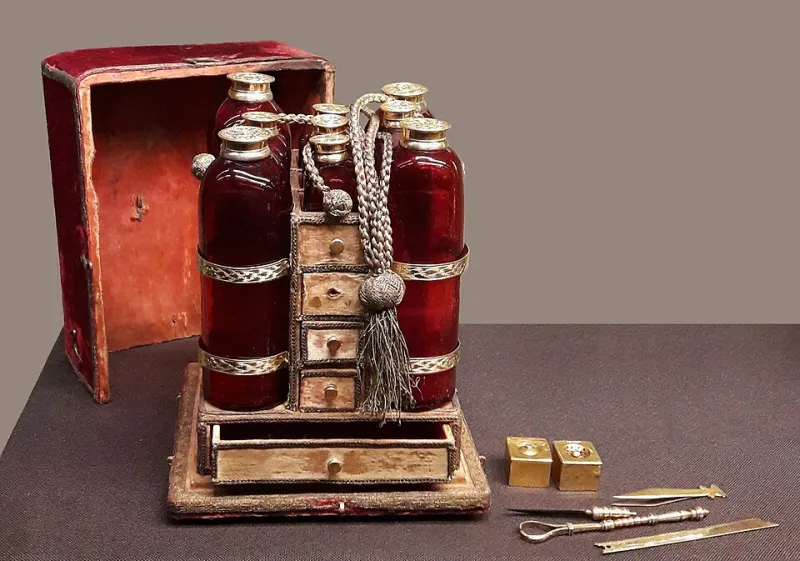
Photo: Anonymous (Southern Germany)Unknown author, CC0, via Wikimedia Commons
Walk into any pharmacy today and you'll find warning labels, dosage limits, and a pharmacist ready to flag dangerous interactions. A century and a half ago, the same errand might have sent you home with a bottle of cocaine-laced toothache drops, a morphine-infused soothing syrup for your teething baby, or a tin of Bayer Heroin — yes, that Bayer, the aspirin people — marketed specifically to calm a child's cough.
This wasn't some shadowy underground trade. It was Tuesday at the drugstore.
The distance between that world and ours isn't just scientific. It's a complete reimagining of what a drug is, who gets to decide, and what the government owes its citizens when it comes to their own bodies.
The Open Shelf Era
In the late 1800s, the United States had almost no federal framework for regulating what went into a medicine bottle. Patent medicines — a term that had little to do with actual patents and everything to do with proprietary secrecy — flooded the market. Manufacturers weren't required to list ingredients. Advertising was limited only by imagination. Newspapers ran full-page spreads for products like Mrs. Winslow's Soothing Syrup, which contained morphine sulfate, and Cocaine Toothache Drops, sold by the Lloyd Manufacturing Company for 15 cents a box.
Heroin, synthesized by Bayer in 1898, was initially celebrated as a breakthrough. It was presented as a non-addictive alternative to morphine — which, by that point, had already created a quiet epidemic among Civil War veterans treated for battlefield injuries. The name "heroin" came from the German word heroisch, meaning heroic. Doctors prescribed it for tuberculosis, bronchitis, and general respiratory complaints. Mothers gave it to children without hesitation.
The concept of addiction as a medical condition barely existed. If someone couldn't stop taking a substance, that was widely understood as a moral failing, not a physiological trap. The drugs themselves were rarely questioned.
The First Crack in the Wall
The shift began not with a health crisis but with a journalism one. In 1905 and 1906, muckraking reporters — most famously Samuel Hopkins Adams in a series for Collier's Weekly — began exposing what was actually inside these miracle cures. Adams called the patent medicine industry "the great American fraud" and documented case after case of products that were either useless or quietly devastating.
Public outrage helped push through the Pure Food and Drug Act of 1906, which required manufacturers to list certain ingredients — including alcohol, morphine, cocaine, and heroin — on their labels. It didn't ban anything. It just forced honesty. And for many consumers, seeing the word "morphine" on a bottle of children's syrup was enough to give them pause.
But the bigger legal reckoning came in 1914 with the Harrison Narcotics Tax Act. Framed as a revenue measure — because the federal government's constitutional authority over public health was murky at best — it required anyone distributing opiates or cocaine to register and pay a tax. In practice, it began the slow process of moving these substances out of the open market and into a regulated medical framework.
When Doctors Became the Gatekeepers
What happened next reshaped American medicine in ways that still echo today. As the Harrison Act was interpreted and enforced through the 1920s, physicians who prescribed opiates to addicted patients — even as a maintenance strategy — found themselves prosecuted. The medical establishment, trying to distance itself from the chaos of the patent medicine era, largely stepped back from treating addiction at all.
This created an almost immediate black market. Substances that had been openly available in pharmacies for decades were suddenly underground commodities. The price rose. The purity dropped. And the people who depended on them had nowhere legitimate to turn.
Meanwhile, the Food, Drug, and Cosmetic Act of 1938 — passed after a batch of improperly formulated sulfa drug killed more than 100 people — finally gave the FDA real enforcement teeth. For the first time, drug manufacturers had to prove their products were safe before selling them. In 1951, the Durham-Humphrey Amendment created the category of prescription drugs, formally dividing medications into those you could buy freely and those that required a doctor's authorization.
The concept of a "controlled substance" as we understand it today didn't arrive until the Controlled Substances Act of 1970, which created the scheduling system still in use. Heroin became Schedule I — no accepted medical use, high abuse potential. Cocaine, despite its long medical history as a local anesthetic, landed on Schedule II.
The Irony That Followed
Here's where history gets genuinely uncomfortable. The same country that spent decades tightening its grip on narcotics found itself, in the 1990s and 2000s, at the center of a prescription opioid crisis that killed hundreds of thousands of Americans. The drugs this time weren't unlabeled patent cures sold by traveling salesmen. They were FDA-approved, physician-prescribed, and aggressively marketed by pharmaceutical companies who assured doctors — and regulators — that newer opioids carried minimal addiction risk.
It wasn't the same as 1890. But it rhymed uncomfortably.
What Actually Changed
The journey from heroin cough drops to the modern pharmacy is often told as a straightforward march of scientific progress — we learned more, we got smarter, we protected people. And that's partly true. We do understand addiction, pharmacology, and drug interactions in ways that would have been unimaginable to a 19th-century patent medicine salesman.
But the story is also about power: who decides what's medicine and what's a poison, who profits from those decisions, and how those lines can shift with politics, culture, and economics as much as with science.
Next time you reach for an over-the-counter painkiller, notice the dosage warning on the label, or need a prescription for something your great-grandmother could have ordered from a catalog — that's not just regulation. That's a hundred years of America arguing about what it owes its citizens, and what it's willing to admit it got wrong.