When Half of America Worked the Land With Their Bare Hands — Before Machines Made Farmers Disappear
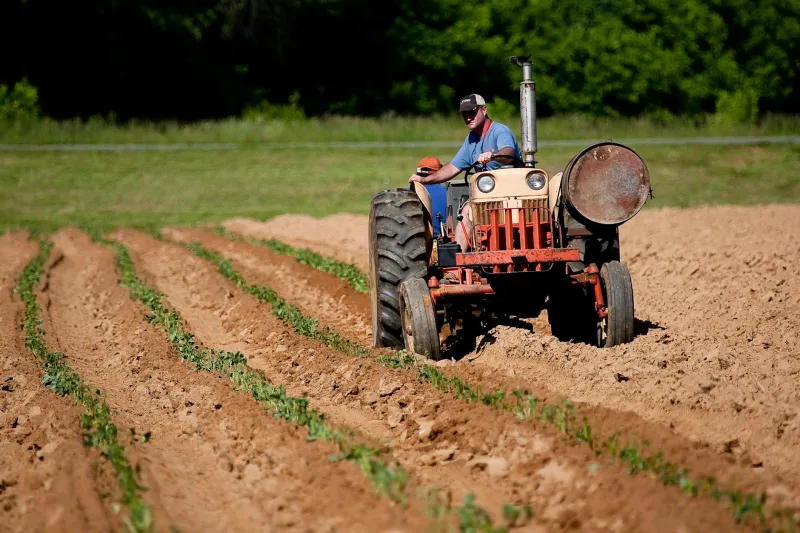
When America Was a Nation of Farmers
Step back to 1900, and you'd find an America that looked nothing like today. Nearly 40% of the population — about 30 million people — worked on farms. Walk through any small town, and chances are most of the men you'd meet spent their days behind a plow, their hands cracked from handling tools, their backs bent from dawn-to-dusk labor in the fields.
Planting corn meant walking behind a horse-drawn planter, dropping seeds by hand into furrows. Harvesting wheat required teams of workers with scythes and sickles, cutting grain stalks one by one before bundling them into sheaves. A single farmer might work 40 acres and consider himself successful if he could feed his family and maybe a few neighbors.
The work was backbreaking, seasonal, and uncertain. A bad harvest could mean hunger. A sick horse could ruin a season. Weather wasn't just small talk — it determined whether your family would have enough money to make it through winter.
The Machine That Changed Everything
Then came the combine harvester.
The first practical combines appeared in the 1930s, but it wasn't until after World War II that they truly transformed American agriculture. These massive machines could cut, thresh, and clean grain in a single pass — work that previously required teams of men working for weeks.
Suddenly, one farmer operating a combine could harvest in a day what had taken a dozen workers a week to accomplish by hand. The machine didn't get tired, didn't need lunch breaks, and could work as long as there was daylight and fuel.
But the combine was just the beginning. Tractors replaced horses and mules. Chemical fertilizers boosted crop yields beyond anything farmers had imagined possible. Pesticides protected crops from insects that had destroyed harvests for centuries. Hybrid seeds produced bigger, more reliable crops.
The Numbers That Tell the Story
The transformation was staggering. In 1900, the average farm produced enough food to feed about 2.5 people. By 1950, that number had jumped to 15 people per farm. Today? A single American farmer feeds approximately 170 people.
Meanwhile, the farming population plummeted. From 30 million farm workers in 1900, the number dropped to 15 million by 1950, then to just 6 million by 1980. Today, fewer than 3 million Americans work on farms — less than 2% of the population.
Yet American farms now produce more food than ever before. The United States exports grain to countries around the world, something that would have been unthinkable when most Americans were struggling to grow enough food for themselves.
What GPS Did to the Last Holdouts
Just when you might think farming had been mechanized as much as possible, GPS technology arrived in the 1990s and 2000s. Modern tractors now drive themselves using satellite guidance, planting seeds with precision that would make a surgeon jealous. Farmers can monitor soil moisture, crop health, and weather patterns from their smartphones.
Drones survey fields for pest problems. Computer algorithms determine the optimal planting density for each section of a field. Some farms operate almost like factories, with climate-controlled environments and automated systems handling everything from planting to harvesting.
The Quiet Exodus From Rural America
As farms became more efficient, something else happened: rural America began to empty out. Small farming towns that once bustled with activity during planting and harvest seasons found themselves with fewer and fewer residents.
The local blacksmith who used to repair farm tools? No longer needed when farmers bought equipment from John Deere dealers in distant cities. The grain elevator that stored crops from dozens of small farms? Closed when corporate farming operations built their own storage facilities.
Entire ways of life disappeared. The knowledge of reading weather patterns by watching cloud formations, of judging soil quality by its smell and texture, of timing harvests by the feel of grain in your hand — all became obsolete as sensors and computers took over these functions.
What We Gained and What We Lost
The gains are undeniable. Americans today spend less than 10% of their income on food, compared to nearly 25% in 1900. We have year-round access to fresh produce from around the world. Famines, once a constant threat, became virtually unknown in developed countries.
The efficiency freed up millions of people to pursue other careers — becoming teachers, engineers, doctors, and entrepreneurs. The Industrial Revolution might not have been possible if half the population had remained tied to farms.
But something was lost too. The connection between people and their food, the understanding of seasons and weather, the tight-knit rural communities where everyone knew their neighbors — these faded as agriculture became an industrial process rather than a way of life.
The New Reality
Today, most Americans are further removed from food production than any generation in human history. Many children grow up thinking milk comes from cartons and vegetables from grocery stores, with little understanding of the complex systems that bring food to their tables.
The few remaining farmers are more like high-tech entrepreneurs than the traditional image of the American farmer. They monitor commodity prices on global markets, use satellite imagery to optimize crop yields, and operate equipment worth hundreds of thousands of dollars.
In less than a century, America transformed from a nation where nearly everyone understood farming to one where almost no one does. It's progress that fed the world — but it also marked the end of an era when most Americans lived close to the land that sustained them.