Your Grandfather Could Fix a Radio With a Coat Hanger. Now We Toss Out $2,000 Phones Over Cracked Screens.
When Broken Didn't Mean Worthless
In 1955, when Eleanor Thompson's Kenmore washing machine started making that grinding noise, she didn't Google "new washing machines near me." She called Mr. Kowalski down at the appliance repair shop on Main Street. Within two days, he'd replaced a worn belt and a few bearings for $8, and that machine hummed along for another fifteen years.
Eleanor's story wasn't unusual—it was American life. From coast to coast, neighborhoods buzzed with the sounds of repair: the tap-tap-tap of shoe cobblers, the whir of sewing machines mending torn fabric, and the gentle hum of television repair shops where men in white coats performed surgery on massive wooden consoles.
Back then, repair wasn't just practical—it was a point of pride. A man who could coax another year out of a lawn mower or a woman who could darn socks so well you couldn't see the hole earned genuine respect from neighbors. Waste was shameful. Ingenuity was celebrated.
The Economics of Making Things Last
The numbers tell the story of a different America. In 1950, the average American household spent just 12% of its income on manufactured goods, compared to 32% today. But here's the twist: those goods were built to last decades, not years.
A Maytag washer from 1960 came with a 10-year warranty and was designed to run for 25 years. The company's "Lonely Maytag Repairman" advertising campaign wasn't just clever marketing—it reflected genuine engineering philosophy. Products were over-built because companies competed on durability, not disposability.
Local repair economies thrived because they made financial sense. Replacing a vacuum tube in your television cost $3. A new TV cost $300—equivalent to about $3,000 today. The math was simple: fix it.
When Main Street Was Repair Street
Every American town had its ecosystem of fixers. The shoe repair shop sat next to the tailor, who shared a block with the radio repair man and the small appliance guy. These weren't just businesses—they were community institutions where neighbors gathered, gossiped, and learned.
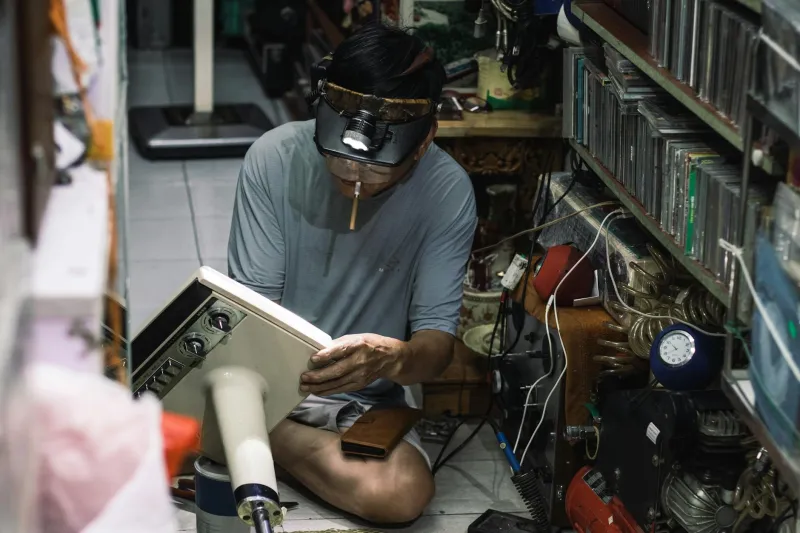
Jim Patterson ran Patterson's Radio & TV Repair in Columbus, Ohio, for forty-three years. His shop was a maze of vacuum tubes, circuit boards, and half-dismantled televisions. "People would bring me anything electronic," he remembered before retiring in 1987. "Radios, record players, electric can openers. If it plugged into the wall, I could probably fix it."
The knowledge was democratized too. Popular Mechanics magazine ran detailed repair guides. Hardware stores sold individual components. Fathers passed down repair skills to sons like family heirlooms. Fixing things wasn't a specialized skill—it was basic adulting.
The Great Shift: When Cheap Beat Repairable
The transformation didn't happen overnight. It began in the 1960s with overseas manufacturing and accelerated through the 1980s and 90s. Suddenly, making products cheaper became more profitable than making them repairable.
Manufacturers discovered planned obsolescence—the art of engineering failure. Products were designed with weak points, non-replaceable batteries, and proprietary screws that required special tools. The message became clear: don't fix it, replace it.
By the 1990s, repair shops were closing faster than family farms. Why pay $75 to fix a $99 microwave? The economics had flipped completely.
The Throwaway Nation We Became
Today's numbers are staggering. Americans generate 292.4 million tons of waste annually—nearly 5 pounds per person per day. We discard 6.9 million tons of electronics each year, much of it still functional. The average smartphone is replaced every 2.5 years, often for cosmetic damage that would have been easily repairable decades ago.
We've created a culture where a cracked iPhone screen—a $30 repair in many countries—becomes a $800 upgrade decision. Where printers are designed to stop working when ink cartridges run low, even if they're not empty. Where car manufacturers void warranties if you take your vehicle to independent mechanics.
The environmental cost is crushing. Electronic waste is the world's fastest-growing waste stream. The energy embedded in discarded products represents billions of dollars in lost resources annually.
The Quiet Revolution: Right to Repair
But something's stirring in America's repair culture. The Right to Repair movement is gaining momentum, pushing back against manufacturers who make fixing impossible. States are passing legislation requiring companies to provide repair manuals and sell replacement parts.
Young Americans are rediscovering repair through YouTube tutorials and maker spaces. iFixit, a company that provides repair guides and tools, has become a multimillion-dollar business. Repair cafes—community spaces where neighbors help each other fix broken items—are sprouting in cities nationwide.
What We Lost When We Stopped Fixing
The shift from repair to replacement cost us more than money. We lost the satisfaction of bringing dead things back to life. We lost the community connections forged in local repair shops. We lost the deep understanding of how our possessions actually work.
Most significantly, we lost the mindset that broken things deserve a second chance—a philosophy that once extended far beyond appliances into how Americans approached problems, relationships, and life itself.
Your grandfather's toolbox told a story of competence and self-reliance. Today's consumer culture tells a different story: when something breaks, you buy a replacement. The question isn't whether we can return to 1955's repair culture—we can't. But we can decide whether the throwaway society we've built is really the America we want to leave behind.