Your Great-Grandmother Washed and Buried Her Own Dead. Here's How Death Became a $15,000 Industry.
Your Great-Grandmother Washed and Buried Her Own Dead. Here's How Death Became a $15,000 Industry.
When your great-great-grandmother died in 1890, her family didn't call a funeral home. They didn't need to. Her daughter washed her body with soap and water in the bedroom where she'd taken her last breath. Her son built a pine coffin in the barn using lumber from the local mill. The neighbors dug her grave in the family plot behind the house, right next to where her husband had been laid to rest five years earlier.
The entire affair cost maybe $5 — the price of the lumber and a few yards of cotton for the burial dress her granddaughter sewed by hand.
Today, the average American funeral costs $7,848, and that's before you add the cemetery plot, headstone, or flowers. A full-service burial easily tops $15,000. What happened between then and now reveals one of the most dramatic transformations in American life — how death went from a family affair to a professional industry.
When Death Happened at Home
In 19th-century America, death was as much a part of daily life as birth or marriage. Families expected to lose children to disease, and most adults died at home surrounded by relatives who'd been caring for them through their final illness.
When someone died, the family immediately went to work. Women washed and dressed the body, often in the person's best clothes or a simple white shroud. Men built the coffin, usually a plain wooden box made from whatever lumber was available. Pine was common because it was cheap and easy to work with.
The body stayed in the family home for the wake — sometimes called "sitting up with the dead." Neighbors brought food, shared stories, and took turns staying awake through the night to keep watch. Children played in the next room while adults paid their respects.
On burial day, family and friends carried the coffin to the graveyard — often just a section of the family farm or a small plot behind the local church. The men dug the grave themselves, lowered the coffin with ropes, and filled it back in. The whole community attended, not because they were invited, but because that's what neighbors did.
The Civil War Changed Everything
The transformation began during the Civil War, when thousands of soldiers died far from home. Families wanted their sons' bodies returned for burial, but transporting a corpse hundreds of miles in the 1860s required preservation techniques most people had never heard of.
Enter the embalmers. These traveling professionals used chemicals to preserve bodies for the journey home. Abraham Lincoln's funeral train, which carried his embalmed body from Washington to Illinois, gave millions of Americans their first look at what professional death care could accomplish.
After the war, some embalmers settled in cities and began offering their services to civilian families. They promised to handle all the messy, difficult work that had traditionally fallen to relatives. For grieving families, especially in growing urban areas where extended family might live far away, this seemed like a blessing.
The Rise of the Funeral Director
By 1900, a new profession had emerged: the funeral director. These businessmen (they were almost always men) didn't just preserve bodies — they managed the entire death process. They provided coffins, arranged flowers, coordinated with churches, and even handled the paperwork.
Funeral homes opened in downtown storefronts, offering families a place to hold services away from their cramped city apartments. The funeral directors marketed themselves as professionals who could provide dignity and respectability for the deceased — qualities that implied the old family-centered approach was somehow undignified or disrespectful.
The industry grew rapidly in the early 1900s. Funeral directors formed professional associations, established training schools, and lobbied for state licensing laws that gradually made it illegal for anyone else to handle dead bodies. What had once been a family responsibility became a legal requirement to hire a professional.
The Casket Upsell
The simple pine boxes of the 1800s gave way to elaborate caskets made from hardwoods, lined with silk, and fitted with ornate handles. Funeral directors convinced families that their love for the deceased could be measured by how much they spent on the burial.
"You wouldn't put your mother in a plain box, would you?" became a common sales pitch. Families who might have spent $5 on lumber suddenly found themselves choosing between caskets that cost $50, $100, or even $200 — enormous sums when the average worker earned less than $500 per year.
The funeral directors also introduced new services that had never existed before. Embalming, once used only for long-distance transport, became standard practice even when the burial happened the next day. Professional mourning became elaborate productions with multiple flower arrangements, printed programs, and hired musicians.
Death Moves to the Institution
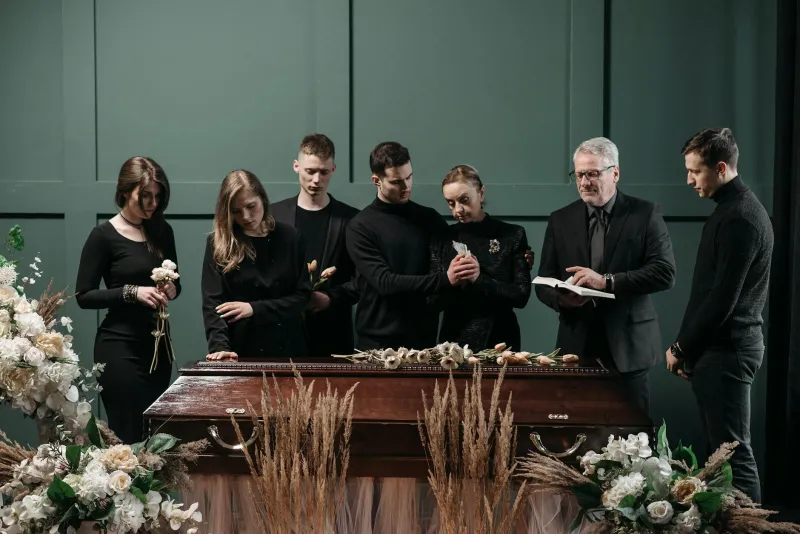
By the 1950s, the transformation was nearly complete. Most Americans died in hospitals rather than at home. Funeral homes had replaced family parlors as the site for wakes and services. Cemetery laws prohibited home burial in most areas, forcing families to purchase plots in commercial graveyards.
The personal, intimate nature of death had been professionalized out of existence. Families who had once washed their own dead now weren't allowed to touch the body without supervision. Communities that had once dug graves together now hired backhoe operators to do the work.
What We Lost
The numbers tell part of the story. In 1900, the average family spent about $25 on a funeral (roughly $800 in today's money). By 2020, that figure had risen to nearly $8,000 — a ten-fold increase even after adjusting for inflation.
But the financial cost may be the least of what changed. Death had been one of the few experiences that brought entire communities together. It forced families to confront mortality directly, to participate in the physical reality of laying their loved ones to rest. Children learned about death by watching their grandparents prepare great-grandmother's body, not by being shielded from the process in a sterile funeral home.
The old way wasn't necessarily better — embalming does prevent disease, and professional funeral directors do relieve families of difficult responsibilities during a time of grief. But something profound was lost when death became someone else's business.
Today, a growing number of Americans are rediscovering home funeral practices, learning to care for their own dead just as their great-great-grandmothers did. They're finding that handling death themselves — washing the body, building the coffin, digging the grave — can be healing in ways that writing a check to a funeral home never was.
Perhaps the most surprising thing isn't how much death care costs today, but how quickly we forgot that we once knew how to do it ourselves.