Flying Was Once a Status Symbol. Here's What Made It Ordinary.
The Golden Age Nobody Could Afford
Imagine saving for three years to take your family on a single round-trip flight to visit relatives across the country. That wasn't a hardship story in 1970—it was the standard expectation for millions of Americans.
A round-trip ticket from New York to Los Angeles in 1970 cost approximately $900. When you adjust that figure for inflation, you're looking at roughly $6,500 in today's dollars. For context, the median household income in 1970 was around $9,900 annually. A family vacation by plane wasn't an option; it was a luxury reserved for business travelers and the genuinely affluent.
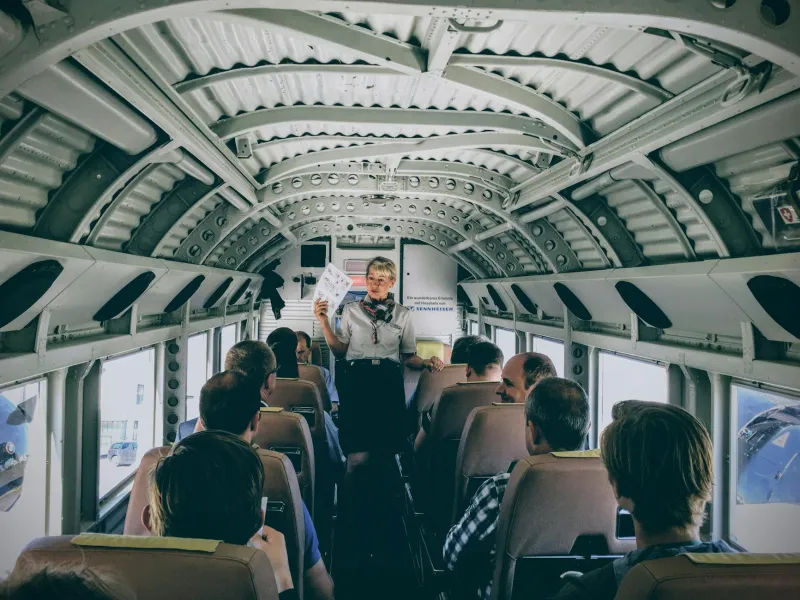
The numbers reveal just how exclusive air travel really was. In 1960, fewer than 10 percent of Americans had ever stepped foot on a commercial aircraft. Flying was so uncommon that the experience itself—the novelty of being thousands of feet in the air—dominated the conversation far more than the destination. Airlines understood this perfectly. They dressed their flight attendants in glamorous uniforms, served multi-course meals on real china, and marketed the journey as an event unto itself.
But here's where the story gets interesting: the system that made flying this expensive wasn't actually driven by the cost of operating planes. It was driven by regulation.
When the Government Controlled the Skies
For four decades before 1978, the Civil Aeronautics Board (CAB) controlled almost every aspect of commercial aviation. They decided which airlines could operate which routes. They approved fares. They essentially carved up the American market like a monopoly game, handing out exclusive territories to favored carriers.
This wasn't accidental—it was by design. After a chaotic period of airline competition in the 1930s, the government decided the industry needed stability. The CAB would provide that stability by eliminating competition on most routes. If you lived in Dallas and wanted to fly to Chicago, perhaps only one airline was legally permitted to serve that route. Prices? Whatever the CAB deemed "reasonable."
The result was predictable: fares stayed high, and they stayed high together. Airlines had no incentive to compete on price because they couldn't. Instead, they competed on luxury—bigger seats, fancier meals, more attentive service. The entire industry was essentially a government-protected cartel, and passengers paid accordingly.
The Deregulation Earthquake
In 1978, President Jimmy Carter signed the Airline Deregulation Act, and the entire system collapsed almost overnight.
Suddenly, any airline could fly any route. Suddenly, airlines could set their own fares. The protected monopolies evaporated, and for the first time in decades, airlines had to compete on price to fill their seats.
The results were chaotic in the short term and transformative in the long term. Within five years, new carriers like Southwest Airlines—founded in 1967 but previously confined to Texas—were expanding nationally. These "low-cost carriers" operated with a radically different model: no meals, no assigned seating, high-frequency flights, quick turnarounds. They made money by filling planes, not by charging premium prices to fewer passengers.
Traditional carriers like TWA, Pan Am, and United suddenly faced competitors willing to undercut their fares by 50 percent or more. The industry went through a painful contraction—several major airlines failed entirely—but the survivors adapted. Fares plummeted across the board.
The Numbers Tell the Real Story
By the mid-1980s, that $6,500 transcontinental flight had dropped to around $2,000 in today's dollars. By the 1990s, it was closer to $1,000. Today, you can find round-trip flights from coast to coast for $200 to $400 if you're flexible and book in advance.
In inflation-adjusted terms, domestic air travel has become roughly 80 to 90 percent cheaper than it was in the regulated era.
The passenger statistics are equally dramatic. In 1970, roughly 15 percent of Americans flew in a given year. By 2000, that figure had climbed to nearly 45 percent. Today, more than half of all Americans fly at least occasionally, and around 25 percent fly multiple times per year. What was once the province of the business elite and the wealthy has become routine—so routine, in fact, that we complain about cramped seats and lack of free snacks.
Load factors—the percentage of available seats actually filled—tell another part of the story. In the regulated era, airlines operated with load factors around 50 to 60 percent. They couldn't afford to fill every seat because they didn't need to; their fares were so high that flying a half-empty plane was still profitable. After deregulation, load factors climbed steadily, reaching 80 to 85 percent today. Airlines now operate on razor-thin margins, which is why they charge for baggage and squeeze rows closer together. But they've also made flying accessible to tens of millions of people who never could have afforded it before.
The Paradox of Progress
Here's the strange irony: air travel is now cheap enough that it's practically disposable, yet the experience itself has become notably less pleasant than it was when only the wealthy flew. The meals are gone. The legroom has shrunk. The seats are narrower. Yet somehow, this is considered progress—and it is, just not in the way the 1970s traveler might have imagined.
When your grandfather took a flight in 1965, it was a special occasion. The airline treated him like a guest. But he was also one of maybe 50 million Americans who flew that year, and he probably paid $1,500 to $2,000 for the privilege.
Today, 2.7 million Americans fly every single day. The person in the middle seat next to you is no longer a member of an exclusive club—they're just someone trying to get somewhere affordable. The transformation from luxury to utility is almost complete.
That's what deregulation really changed: it took something rare and special and made it ordinary. Whether that's an improvement probably depends on how much you valued the free champagne.