The Coast-to-Coast Drive Used to Break Men. Then Eisenhower Changed America Forever.
The Coast-to-Coast Drive Used to Break Men. Then Eisenhower Changed America Forever.
Imagine packing your car for a cross-country trip and also packing a shovel. And a hand-crank jack. And spare axles. And enough food to last two weeks because you genuinely have no idea when you'll reach the next town.
That wasn't paranoia. In 1903, that was just Tuesday.
When Horatio Nelson Jackson became the first person to drive an automobile from San Francisco to New York City, it took him 63 days. Sixty-three days of blowouts, mud traps, broken bridges, and roads that weren't really roads at all — more like suggestions carved into the earth by wagon wheels. He averaged a little over 50 miles a day. Sometimes far less. The car broke down so often that his dog, Bud, became something of a media sensation simply for surviving the journey.
And Jackson was considered a pioneer. A hero, even.
What Passed for a Road in Early 20th-Century America
The United States in the 1900s and 1910s had almost no paved roads outside of cities. What existed between towns were dirt tracks that turned to soup in the rain and cracked like pottery in the heat. River crossings often meant finding a shallow ford and hoping for the best. There were no highway signs, no gas stations in rural areas, and no guarantee that the "road" shown on a map actually connected to anything useful on the ground.
Early cross-country drivers carried instruction booklets — essentially handwritten guides that said things like "turn left at the dead oak tree" or "ford the creek after the Miller farm." The Lincoln Highway, established in 1913 as America's first transcontinental route, was a patchwork of local roads stitched together by optimism more than engineering. Sections of it were unpaved well into the 1930s.
A successful New York-to-LA drive in that era took anywhere from three to six weeks depending on weather, mechanical luck, and the driver's willingness to sleep in fields. Most Americans simply never attempted it.
The General Who Built the Roads
Dwight D. Eisenhower had seen what good roads could do. During World War I, he'd watched the U.S. Army struggle to move equipment across the country on crumbling infrastructure. Then, as Supreme Allied Commander in World War II, he'd driven on Germany's Autobahn and understood immediately what a modern highway network could mean — not just militarily, but economically and socially.
When he became president, he acted on it.
The Federal Aid Highway Act of 1956 authorized the construction of 41,000 miles of interstate highways — the largest public works project in American history at that point. The government would fund 90% of the cost through a new federal gas tax. States would handle the rest. The interstates had to meet strict standards: wide lanes, gentle curves, controlled access, no traffic lights, and overpasses tall enough to clear military vehicles.
Construction took decades and cost over $500 billion in today's money. But what it created was nothing short of a new country.
America After the Interstate
By the 1970s, you could drive from New York to Los Angeles in roughly 40 to 45 hours of driving time — spread over four or five days for most people, or pushed into three with long hauls. The route was paved, signed, lit, and lined with rest stops, motels, and diners. The ordeal Jackson had survived in 63 days became a family road trip.
The cultural ripple effects were enormous. Suburbs exploded because people could commute. Trucking became the spine of American commerce — today about 70% of all freight in the US moves by truck, most of it on interstates. Fast food chains standardized their menus partly because highway travelers needed predictability. The motel industry was essentially born from the interstate. So was the concept of the American road trip as a rite of passage.
Route 66 became a myth. Kerouac wrote On the Road. Station wagons filled with families became a cultural archetype.
The Drive Today
Pull up Google Maps right now and ask for directions from New York to Los Angeles. It'll tell you 2,790 miles, approximately 40 hours of drive time, and it'll route you with real-time traffic updates, warn you about construction zones, and suggest rest stops along the way. Your car's GPS will recalculate silently if you miss a turn. You'll never once need a shovel.
The modern cross-country drive is so manageable that people do it recreationally. They do it on a whim. They document it on TikTok. They argue about whether to stop in Nashville or push through to Oklahoma City.
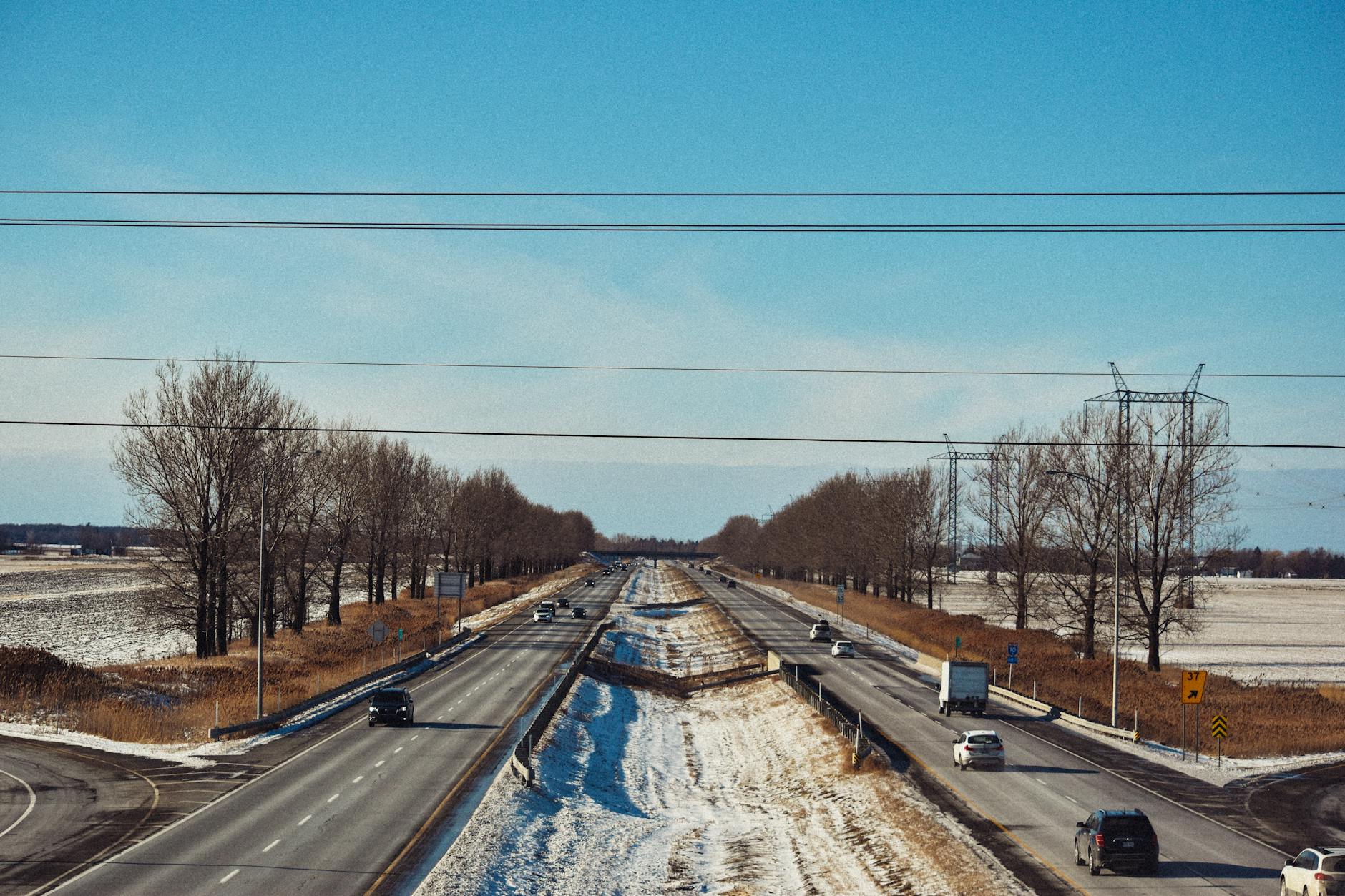
The roads Eisenhower built didn't just connect cities. They connected the idea of America to itself — made it tangible, drivable, knowable in a way it had never been before. Before the interstate, the American West was still, psychologically, a frontier. After it, the whole country fit inside a long weekend.
Horatio Jackson drove 63 days with a shovel and a lucky dog just to prove it could be done.
Now we complain if there's construction near Amarillo.
That's not ingratitude. That's just how completely the world changed.