Americans Once Memorized the Stars to Navigate at Night. Now We Panic When GPS Loses Signal.
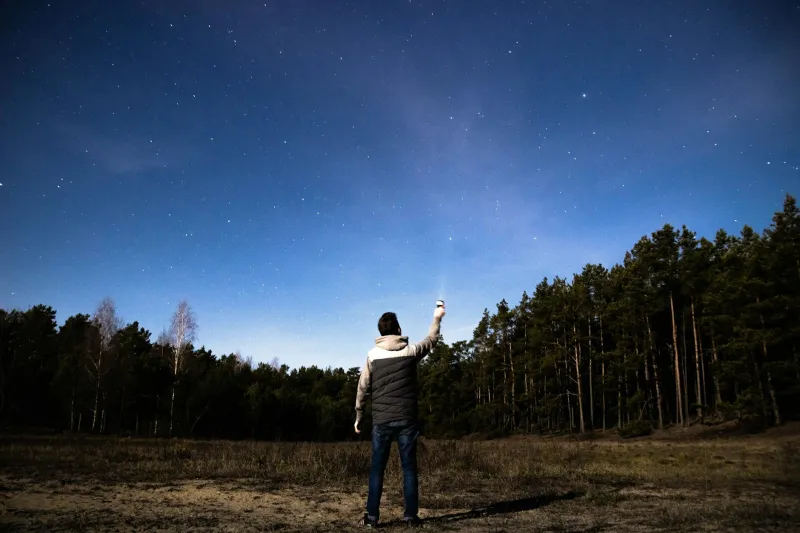
When the Sky Was America's Highway Map
In 1970, if you asked a random farmer in Iowa or a fisherman in Maine to find north using the stars, they'd point to Polaris without hesitation. Ask that same question today, and you'll likely get a blank stare followed by someone reaching for their phone.
This isn't ancient history we're talking about. As recently as the 1980s, millions of Americans possessed basic celestial navigation skills that had been passed down for generations. Boy Scouts earned merit badges for it. Farmers used star positions to time their planting. Sailors on the Great Lakes relied on constellations when fog rolled in. Even suburban dads teaching their kids to drive would point out the Big Dipper as a backup compass.
Then GPS satellites started talking to civilian devices in the 1990s, and within two decades, we collectively forgot how to read the sky.
The Lost Art of Finding Your Way
Before GPS became standard in cars around 2005, Americans developed an intimate relationship with their physical surroundings that's hard to imagine today. People memorized not just star patterns, but the way shadows fell at different times of day, how mountains looked from various angles, and which way streams flowed in their region.
Take the Appalachian Trail, for instance. In the 1960s and 70s, hikers navigated hundreds of miles using topographic maps, compass bearings, and celestial reference points. They'd identify their position by triangulating between visible peaks, noting the angle of the sun, and checking their progress against known star positions at night.
Today's hikers carry GPS devices that pinpoint their location to within three feet. The technology is undeniably superior—but something fundamental has been lost in the translation.
When Your Phone Dies in the Woods
The difference becomes stark when technology fails. In 2019, rescue teams in national parks reported a 300% increase in calls from lost hikers compared to the 1990s, despite trails being better marked and more crowded than ever before. The common thread? Dead batteries and lost GPS signals.
Search and rescue coordinator Mike Chen from Yosemite explained it this way: "Twenty years ago, if someone got lost, they usually had backup skills—they could read terrain, follow water downstream, or use the sun's position. Now people panic the moment their GPS stops working. They've never learned to look around and figure out where they are."
This helplessness extends far beyond hiking trails. In urban areas, studies show that people who rely heavily on GPS navigation develop weaker spatial memory and struggle more with basic wayfinding when technology isn't available.
The Speed of Forgetting
What's remarkable is how quickly we abandoned these skills. The transition happened faster than almost any other technological shift in American history.
In 1995, the average American driver kept paper road atlases in their car and could read them competently. By 2010, AAA stopped printing most of their regional TripTik route guides because demand had evaporated. Today, many young adults have never used a physical map for navigation.
The same pattern played out with celestial navigation. Amateur astronomy clubs across the country report that their "basic star navigation" workshops—once among their most popular offerings—now struggle to fill seats. The knowledge that helped humans navigate for thousands of years became irrelevant to most Americans in less than a generation.
What We Gained and What We Lost
To be clear, GPS technology represents an extraordinary leap forward. Modern navigation systems prevent countless accidents, reduce fuel consumption, and make travel accessible to people who might otherwise struggle with traditional wayfinding.
But the trade-off runs deeper than simple convenience. When Americans routinely read star charts and topographic maps, they developed what psychologists call "spatial intelligence"—an intuitive understanding of how landscapes connect and how position relates to direction and distance.
This kind of thinking carried over into other areas of life. People who could navigate by stars typically showed stronger problem-solving skills, better memory for spatial relationships, and more confidence in unfamiliar situations.
The Backup Plan We Threw Away
Perhaps most concerning is our complete dependence on a system we don't control. GPS relies on satellites maintained by the U.S. military, and the signals can be disrupted by everything from solar storms to technical malfunctions to deliberate interference.
In contrast, the stars have been reliable navigational aids for thousands of years. They don't need batteries, can't be hacked, and work anywhere on Earth with a clear view of the sky.
Yet most Americans under 40 couldn't find their way home using celestial navigation if their lives depended on it. We've traded a backup system that worked for millennia for the convenience of turn-by-turn directions—and never considered what happens when the satellites stop talking.
Looking Back at the Sky
The irony is that basic star navigation isn't particularly difficult. With just a few hours of practice, anyone can learn to identify major constellations and use them for general direction-finding. Our grandparents learned these skills as children, the same way kids today learn to swipe and tap.
But we've become so accustomed to precise, instant navigation that the idea of approximate, skill-based wayfinding feels primitive. We've optimized for convenience and lost touch with self-reliance.
The next time your GPS loses signal and that familiar panic sets in, remember: your grandfather would have just looked up at the stars and kept walking. He knew something about finding his way that we've forgotten how to remember.